Ibrahim Maalouf’s Trumpets of Celebration
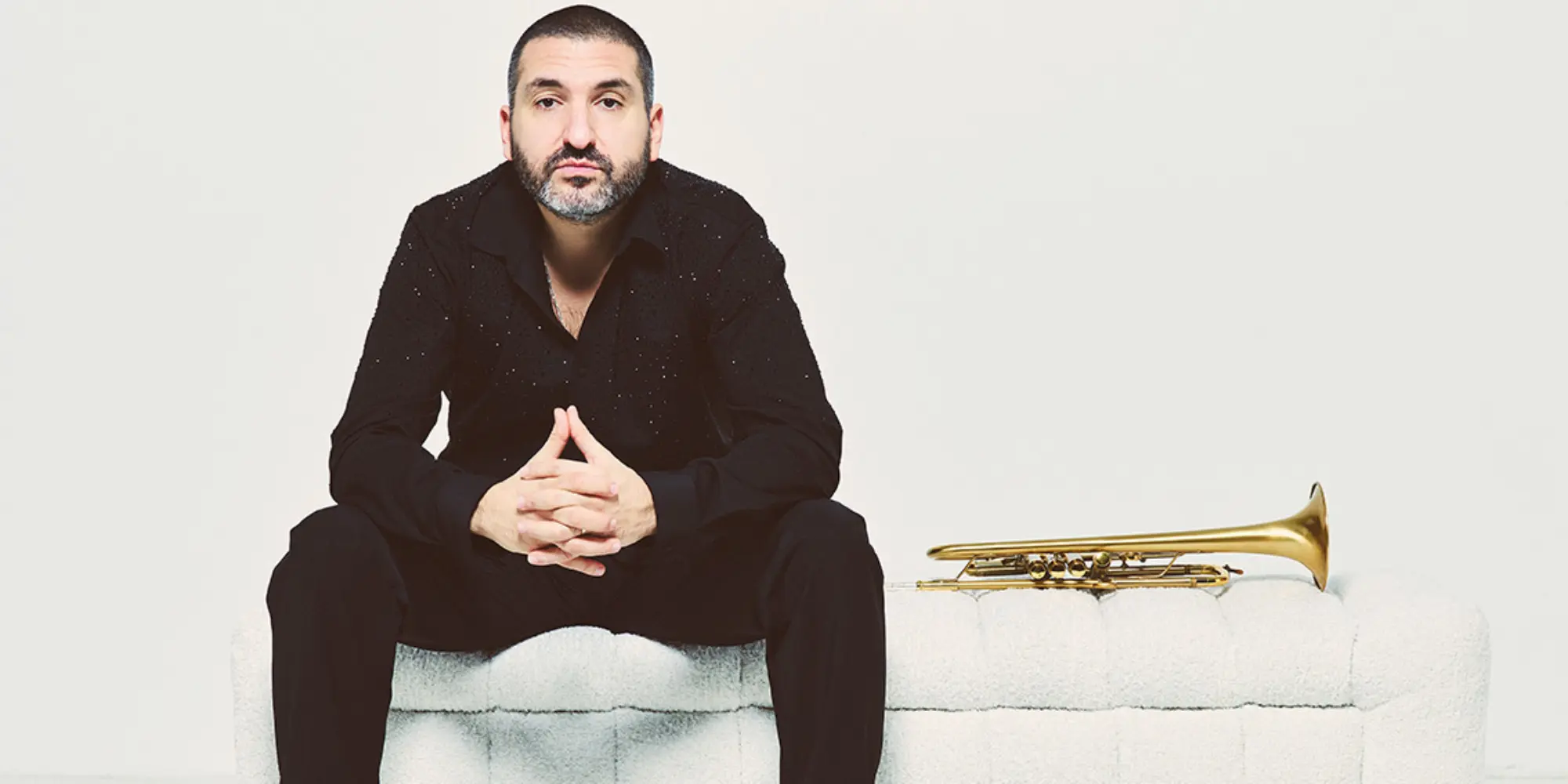
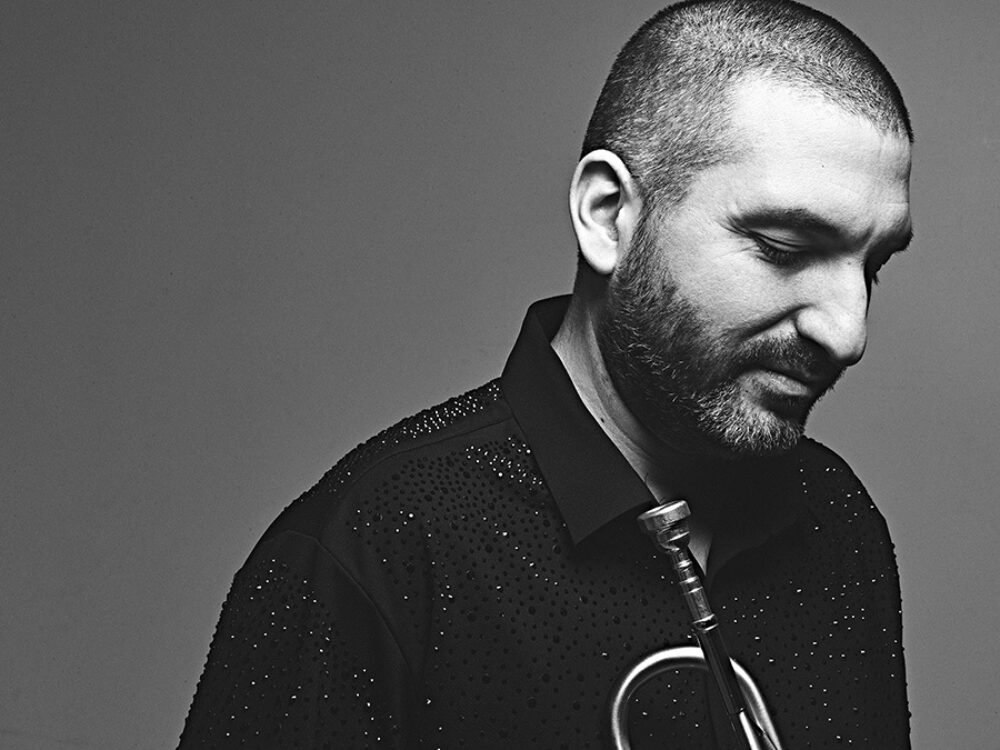
For a classically trained trumpet player, born in war-torn Lebanon and raised in France, the prospect of having a global career a genre-defying bandleader, embraced by Quincy Jones’s inner circle, producing some 21 albums (so far) and performing in more than 40 countries, must have seemed remote. But that has been the path of Ibrahim Maalouf. As we learned in an earlier interview, Maalouf’s father invented the quarter-tone trumpet, allowing him to play the complex, microtonal modes (maqamat) of Arabic classical music. That was the beginning, but over the years, Maalouf has blurred the lines between jazz, pop, folklore and classical tradition to create a singular body of work.
It all springs from his glorious tone on his instrument, and a keen eagerness to break rules and try new things. These talents have attracted collaborators from Stevie Wonder and Angelique Kidjo, and, on his new album Trumpets of Michel Ange, Volume 2, Jon Batiste, Gonzalo Rubalcaba and Weedie Braimah. Afropop’s Banning Eyre reached Maalouf, who was on tour in Turkey, en route to North America, including a gig at New York’s Sony Hall on June 29.
Here's their conversation.
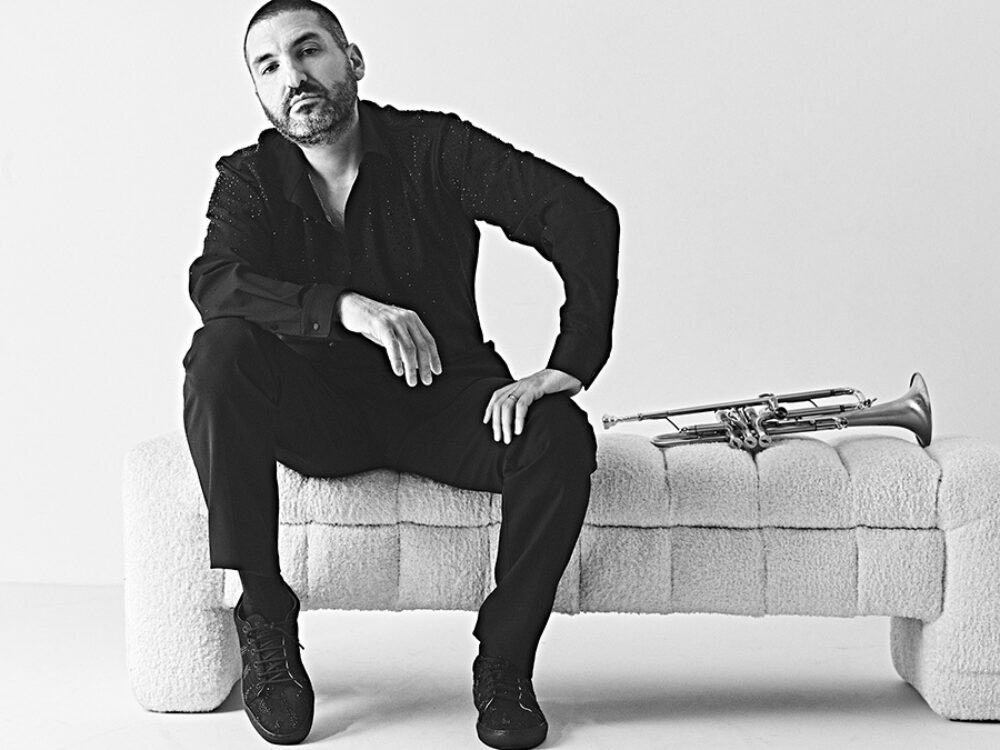
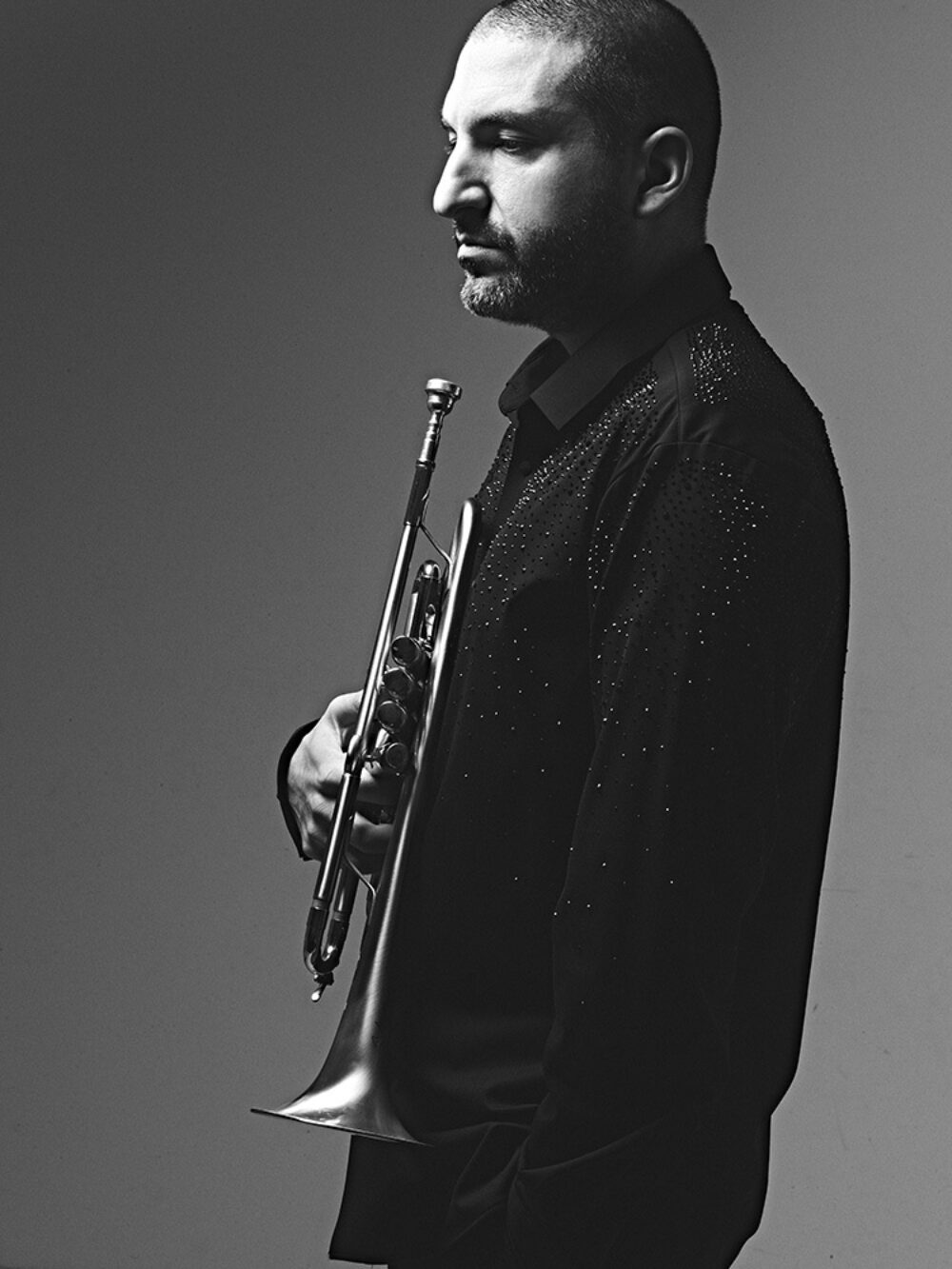
Promo photos by Arno Lam.
Banning Eyre: Ibrahim. Good to see you again. Where am I finding you?
Ibrahim Maalouf: We are touring in Turkey. We were yesterday in Busan and the day before in Izmir. Tonight is in Ankara.
Wow. You're in the midst of things. Well, thanks very much for taking the time.
No, no, that's normal man. And I remember you, I remember our conversations and thank you.
Yes. We’ve had some good conversations, so we won't go back over any of that. We'll talk about the new album, which is really lovely. One thing I didn't ask you last time, which applies to this album, is the title, Trumpets of Michel Ange. What’s the story there?
Michel Ange is the French version of Michelangelo. So, you know, the name is related to so many meanings. But mostly, when I was a kid, my father always used to tell me his story of how he invented the quarter tone trumpet. When he arrived in France, he was a young student and he found shelter in a very small church, like one of the oldest churches in Paris, it's called Saint-Julien-le-Pauvre. It's a very, very old church, and this is where he was working. It was his first job. And this is where he was practicing trumpet also, in that little church like a chapel. It’s also where he designed the first version of the trumpet he wanted to invent.
So that was in the ‘60s. And when he was telling me this story, when I was a kid, somehow I pictured him in a chapel, with Michelangelo’s painting, you know, the beautiful painting in the Sistine Chapel. For me as a kid, I was imagining my father as this crazy painter doing his drawings and playing his trumpet and all this. So I grew up with this picture somehow. And I just kept it for me; I never really talked about it. And when I had to make a decision to how to name this trumpet—because the trumpet didn't have a name—I wanted to pay a tribute to these memories I had from my father's story. And I decided to call it the Trumpet of Michelangelo.
Well, that's beautiful. That explains why it means so much to you. So this is Volume 2, and to me, it feels to me more intimate than Volume 1, and certainly more intimate than the big Paris concert we spoke about last time. The exception to that might be the first track, “Bring the Light,” which has a number interesting people on it including Jon Batiste and some folks we know well like Pedrito Martinez, and Weedie Braimah. How did that song come together?
Exactly like you imagine it, a bunch of friends, a bunch of people who really respect each other and who love to play with each other and who happen to be in the same jams, in the same concerts, and of course through Quincy Jones, who brought many of us together for concerts and jams. The first volume of the Trumpets of Michel Ange was the wedding, and this part I wanted to be the celebration of the wedding. So I wanted to start the celebration with the friends, the way you would celebrate a wedding.
So a bunch of friends, all of them mind-blowing musicians and human beings, and you know, it was obvious to me that the album had to start with this. We’re all coming from different places in the world, bringing together a spirit of love, of light, and celebrating our diversity, our differences of religions, origins, styles. It all came together into one color. That was really the idea, especially now when you see the situation in the world, we definitely need something that unites us.
Absolutely.
But beyond all the differences, I think that someone like Jon, or Weedie Braimah, all the guys, I mean, they live this love and this light very differently. Each one of us shares this love and this light in different ways, but we all share it. And in my opinion, this is what jazz is about.
Did you record all together? Were you all in one place to record that track?
I wish! It was so frustrating.
I can imagine it would be very hard to get all these people in one place.
Impossible. But we almost got them all in the same time. Jon is so hard to catch, you know, Jon is so crazy. So Jon, for example, we were together in Miami, and a few days before we were in L.A., and it's been a long time, I sent music to him and I said, “Man, you're the one who's going to bring that light, because this is the voice I would like. I would like you preaching on this. I would like to have your voice on this song.”
That’s his joyful shout at the beginning, right?
Yes. Everything, all the vocals, that’s him, except the gospel choir obviously. Everything else, it's his voice. Jon has brought something to my life that nobody did before. I don't know how to call this. It's a mix between innocence and genius. When I met him was one of the only times in my life when I met someone he gave me hope. He has this magic thing. He's completely crazy, and then it's difficult to catch him. It's even difficult to understand sometimes how he works, but there is something magic in him. It comes with something about freedom. When I'm with him, I feel like I must have superpowers, you know? I feel like superman, like everything is possible musically speaking. Everything is possible. I don't know where this comes from in his life, but he has this superpower and I knew that he was the one who was going to catalyze all these energies around me and bring them to one specific spot that will give meaning for the whole song.
Beautiful. It's a wonderful track. Obviously, Pedrito Martinez is a percussion genius. And Weedie is such an unique character.
These people—all of them are geniuses. Each one of them shares it in a different way, even someone more mysterious like MonoNeon, and Anthony Evans is such a beautiful soul and his voice and his gospel choir—all of them were so dedicated to the song when they came to record. It’s something deep that was shared when we recorded this.
You talk about this being a wedding celebration, and I feel like I’m hearing more traditional Arabic rhythms in these songs. It feels less like jazz and more close to Arabic traditional. The song “Leyla's Wedding” is a prime example, but there are a lot of the classic rhythms of Arabic music in here, right? The track with Gonzalo Rubalcabo, “Oui, Je Le Veux,” for example. It starts out as a ballad, and then it drops into… what is that rhythm that it drops into there?
We call this baladi. It's like a popular rhythm in the Arab context.
Yes, very familiar.
But you know… Let me put it this way. When my mother speaks, she uses her hands a lot, because it's her Arabic accent, right? So when she speaks French, or when she tries to speak in English, she has this very Arabic accent. So when you're French, or American, or English, or anything, and you listen to her speaking, you would say, “Oh, obviously, she's Arab.” But if you see it from the perspective of an Arab, and you listen to my mom speaking, you would say, “Oh, she's definitely French.”
Really?
Yes, because when she speaks Arabic she has a French accent, but this is something you don't hear when she's speaking French. Why am I saying this? Because I completely understand your perspective as a non-Arab, listening to these songs with this darbuka and these Arab instruments and rhythms. But if you ask an Arab, if this music is Arabic music, he would say, “No, not at all. This is maybe jazz fusion or I don't know what.” The perspective changes the way you define things. And I completely agree with you, but I would completely agree with you if you would have said the exact opposite, depending on where you're talking from, which point of view you're talking about.
Interesting. So you would say that even about the tune “Layla's Wedding,” which really does feel like a wedding song.
Yes, definitely. I would say because, you know, the, for example, in Arab music, you wouldn't hear something like this. [sings a funky rhythm].
No, that sounds like something out of New Orleans funk.
Or big band music. You know, it could be a Cuban thing.
Yeah, sure.
So for many reasons, I really truly believe in Creole culture. For years, I've been dreaming of a world where Creoleization would be more valued. I've been struggling with this since 20 years ago. When I would go to a record company, showing my music, playing my music to them in their office… “Hey, my name is Ibrahim. I'm Lebanese originally, but I live in France. This is my music. I play a quarter-tone trumpet, I'm 22 years old, I was raised in a classical music family but I play also other kind of things.”
They listen to the music and they look at me with some kind of pity and they say, “Wow your music is really cool, but we don't know how to sell this. We don't know what to call it. You're not playing Arabic music. Maybe you should put on the tarbush and put maybe a jelab on or something. Maybe dress like Tinariwen or stuff like this, you could define it. Or maybe you could sing. Do you sing?” I'm like, “No, I'm a trumpet player.”
Yeah, yeah, I've been struggling with this from 2003 until 2007, I think I pretty much got meetings with all jazz labels in the world. And all of them told me my music was amazing. I don't know if they were honest or not, or if they were just being nice to me. But all of them were like, “Wow, really cool. And wow, wow, you're a good trumpet player,” and da-da-da. And everybody said no. So that's why I did my label. That's why I put together a bunch of friends, and I said, guys, “Let's do a label, let's do something. Because otherwise, I'm just not gonna do music, and that's not an option to me. So let's do a label.” That's why I did my label [Mi’ster Productions] 20 years ago.
The reason why I did this is that people couldn't understand that you can be so many things at the same time. It doesn't have to be only one specific identity. And that says a lot about our societies where we expect you to be one specific thing. Are you Christian? Are you Jewish? Are you a trumpet player? “That's your idea. No, I'm not. I'm a composer.” Oh, you're a composer. You're not a trumpet player. “Yes, I am a trumpet player. And I play piano too.” Oh, so you're a pianist. “No, I'm not a pianist.” You always have to define something. People have to put you in a specific box, like you, for example, you're a journalist. Come on. I'm 100% confident that you're much more than just someone who's asking a musician.
Yes, I’m also a guitar player, and I have this problem too.
You’re a musician. You're so many things at the same time.
I relate to that very well, and I think a lot of the artists that we've been dealing over the years in Africa have dealt with this too, because there are so many influences coming in and people want to try things, extend their limits. And that complicates their identity. Sometimes it's the audience themselves who are very narrow with their categories. I think about Congolese music, which I love, but any artist that departs enough from the expected formulas risks being rejected by the home audience. But in your world, do you think that's changing at all? Is there any progress on that front?
I think that we have a role as artists to not follow the rules, but to change the rules. I mean, look, when you look at fine arts or cinema or literature or fashion, the people who change things are the ones we remember, and the ones who follow, we don't really remember them. Our role as artists is to change the rules, not to follow the rules. Art is made to break rules. It's the philosophy of art. That's why we're here, because if we follow rules, we follow dictators, we follow cowardness.
You know, I think of our friend, Angelique Kidjo. I was just reviewing her new album, which has everybody in the world guesting on it. She is kind of like you. She loves to collaborate. Anyway, I went back and I read the review that I wrote of her very first album back in like 1991. And it was sort of the same idea. It was like, “A lot of purists might not like this. She’s singing in African languages, but the music's very international, very funky...” Angelique is someone who exemplifies what you're talking about, because she's dipped into every genre you can think of, and she's on top of the world.
She is free. This is what freedom is about. And that's why I love Angelique. Because she doesn't really care what people think about her. Honestly, she doesn't care. In a very genuine and authentic way, and in a very nice way, not like “I don't care about you.” It's “I don't care, but I love you. I don't care if you like me or not. I'm doing what I have to do.” And that's our mission as artists. It's the reason why I do music, otherwise I wouldn't do music, I would do something else.
Let me ask you about the song, “Chasing the Sun,” which has a strong flamenco aspect to it. Who is that singing?
She is one of the members of Las Migas. Las Migas is a quartet. A few of them play guitar, a few of them sing, they do the palmas [flamenco clapping] and one of them plays violin. They are from Spain and they are amazing. I just discovered them a few months ago. I was really blown away by the way they see flamenco. They really respect the traditions, but at the same time, they try to go a little bit outside of it and try some other things. And I wanted a different perspective on my music, someone who brings something different. And it felt to me that what we did with Richard Galliano, the legendary accordionist, was really nice, but it needed something a little different. It turned to me it was a little bit too much jazz, too much Argentinian. I was I was wanting something more Latino, you know? So when I heard Las Migas, I sent the music to them and they they immediately sent back a message saying, “We definitely agree with you. There's definitely some space for us on this, so let's do it.”
When I first heard this track, I thought it might be Buica. She’s also an artist schooled in flamenco, but very free.
Absolutely. Buika. I heard her like 20 years ago, and at that time when I heard her, I was playing with Lhasa de Sela [Mexican-Canadian singer], and for me, there was something very much alike in the way they shared the music and their voices, something broken in them that is deep, that goes deep in our hearts. I love Buika. I would love to do something with her one day.
I hope that happens. The last song on the album, “Hold Your Piece,” has got this great sort of 6-8 jazz swing to it. It's the jazziest song on the album, really. And it features that accordion.
That’s the accordion of Richard Galliano.
And there’s a big brass-section sound. I'm just curious about your method. For “Bring the Light,” you couldn't have everyone together, but in general, for most of these recordings were you able to bring the artists together and do it live in a studio? How do you go about pulling together so many diverse talents?
Let's talk about this album, because it's not always the same, depending on where you are. But for this album, we recorded everything live except Jon and the guys of “Bring the Light,” and Las Migas, and Nai Barghouti, the Palestinian singer. Pretty much all the other artists in the band, the trumpet, the saxophone and the drums—everybody was live in a studio that is near Paris. It's called Medoun. I don't know if you noticed, but we also had people with us, an audience. So we recorded this live with people around us. I wanted this to sound like a live show, with people clapping and dancing. So we did it live with everybody, except those who couldn't be with us, unfortunately. And then we did the ones that were not there later.
You are now touring with your own ensemble. How big a group?
We are 10 people on stage. We are playing Volume 1 and Volume 2 of The Trumpets of Michel Ange. So you can imagine, it's a wedding party. People are dancing, singing, and all the audience is dancing with us and singing. It's very, very, very festive, like a big party. We have a dancer also, she's amazing, originally from Cameroon, and she dances like gypsy dances and Arabic dances and African dances. She mixes all kinds of dance together. We have an Armenian drummer, Jeanette Guillaume. We have a Belgium guitarist. We have an Algerian trumpeter, another Lebanese trumpeter, a Tunisian trumpeter, a Roma gypsy, saxophone player. It's a band I love, with all different cultures together.
And I see you're going to be in New York on June 29th. I plan to be there.
Please come. You're gonna love the it energy.
I applaud you for making the effort to come here. It’s not easy!
That’s true. It's not easy in the United States, because we are so many people on stage. We are 17 people traveling, so it's quite difficult, economically speaking. There are some places where people really don't know me at all in the United States, so we have to work on this.
Well, we'll do what we can to get the word out. It's such a difficult time now. So many artists we love cannot come here now.
But you know why we are going to the United States? Why? Because I'm losing money and I'm fine with that. I mean the visas and the travels and the hotels… Oh my god! So expensive! But I think it's a mission. Really. I'm trying to be honest. As you can see usually artists would not tell you they are losing money. It's not really prestigious. But it’s true.
Anyway, I'm trying my best. I think through music… Even when we go to places where I don't know so many people, like yesterday we played in Busan. I didn't know there were people who know me in Busan. And then we were playing in front of something like 2,000 people, and at some point I was wondering, “Do they know me, or did they just come because there was an exotic trumpet player?”
After the show I was talking to people. You know, I do pictures, they come, we do pictures and all this and I was asking them, “How did you know about me?” Some say internet, Google, YouTube, you know, some people say, “Oh, it's just a friend who told me to come and I just came.” But all of them, all of them, whatever is the reason why they were there, whether they knew me or not, all of them, they looked so happy, and that changes everything for me.
Well, you have such a unique sound. I mean, I remember the first time I heard you play was at the Lincoln Center Atrium in in New York years ago, and as soon as I heard your sound I was hooked. When I was a kid I was a huge fan of Herb Alpert. I wound up a guitarist, but back then, I wanted to play the trumpet.
I love it.
We just saw Herb recently with the reunited Tijuana Brass. At age 90, the man is amazing. Sounding good too. But I don’t think I ever got so excited about a trumpet player again until I heard you. So I can imagine once people have the experience, they get curious.
You know I'll just tell you a funny thing in passing. A guy that is now my friend in Amsterdam, Jan Wouter Oostenrijk, wrote this book called Maqam Guitar. It's a book about how to play maqam music on guitar. He actually makes quarter-toned guitars, but he also shows ways to approach microtonal music with a standard guitar. I interviewed him the other day [stay tuned, readers…], and he's a very interesting guy. But he just published this book, so maybe now you're going to start seeing maqam guitar players cropping up here and there.
You know who plays the maqams really good on guitar? It's the gypsies, the Serbian gypsies.
That makes sense.
They're really good at this, because they mix Middle Eastern and Western music. They're in the middle of two worlds.
A good place to be. Well thanks very much for taking your time, Have a wonderful show tonight and I will look for you on the 29th at Sony Hall.
Yes, and thank you very much.
IBRAHIM MAALOUF 2026 TOUR DATES
Jun 19, 2026 - Los Angeles, United States - The Troubadour
Jun 20, 2026 - San Francisco, United States - Regency Ballroom
Jun 22, 2026 - Portland, United States - The Den
Jun 23, 2026 - Seattle, United States - The Crocodile
Jun 25, 2026 - Vancouver, BC - FIFA Fan Festival™ Vancouver, Hastings Park
Jun 27, 2026 - Toronto, Canada - Danforth Music Hall (Toronto Jazz Festival)
Jun 28, 2026 - Ottawa, Canada - Confederation Park (Ottawa Jazz Festival)
Jun 29, 2026 - New York, United States - Sony Hall (Blue Note Jazz Festival)
Jul 1, 2026 - Montreal, Canada - MTelus (Montreal Jazz Festival)
Jul 8, 2026 - Puget-sur-Argens, France - Le Mas des Escaravatiers
Jul 17, 2026 - Ostrava, Czech Republic - Festival Colours
Jul 30, 2026 - Marciac, France - Jazz in Marciac
Nov 4, 2026 - Milan, Italy - Arcimboldi
Nov 5, 2026 - Florence, Italy - Teatro Cartiere Carrara
Nov 11, 2026 - Lörrach, Germany - Burghof
Nov 13, 2026 - Monheim am Rhein, Germany - Kulturraffinerie K714
Nov 14, 2026 - Dortmund, Germany - Konzerthaus
Nov 17, 2026 - Mérignac, France - Pin Galant
Nov 18, 2026 - Toulouse, France - Casino Barrière
Nov 19, 2026 - Grenoble, France - Le Summum
Nov 20, 2026 - Lyon–Décines, France - FIDUCIAL Astéria
Nov 22, 2026 - Déols, France - MACH 36
Nov 24, 2026 - Biarritz, France - Gare du Midi
Nov 27, 2026 - Dubai, United Arab Emirates - Opera
Dec 4, 2026 - Limoges, France - Opéra
Dec 5, 2026 - Montluçon, France - Centre Athanor
Dec 8, 2026 - Clermont-Ferrand, France - Maison de la Culture
Dec 10, 2026 - Annecy, France - L'Arcadium
Dec 15, 2026 - Marseille, France - Le Silo
Dec 16, 2026 - Lens, France - Le Colisée
Dec 17, 2026 - Lille, France - Casino Barrière
Related Audio Programs
Spiritual Journeys: Tarab: The Art of Ecstasy in Arab Music
The Art of Improvisation: Part 1
Related Articles